How Tomcat’s Quick Release Frame Made Adaptive Trikes Practical for Families
One of the most common questions families ask is simple:
“How do we get the trike in the car?”
For many adaptive cycles, transport can be a real challenge. Trikes are often large, awkward to lift, and difficult to dismantle.
At Tomcat, we solved that problem decades ago with a feature that has become one of our most important engineering innovations: the Quick Release Frame.
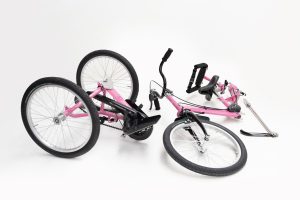
Where the Idea Began
The Quick Release Frame first appeared on trike number three, for a young rider called Kevin White.
Kevin was a wheelchair user with Williams Syndrome and was beginning to gain weight. His parents were looking for a way to help him become more active, so my newly developed Carer Control system seemed like the perfect solution.
But there was one practical issue.
The trike needed to fit in the family car.
That meant it had to dismantle quickly and safely.
Why I Didn’t Want a Folding Trike
At the time, folding trikes already existed, but they came with problems.
Even when folded, trikes remain large, awkward, and heavy to handle. They also tend to introduce unwanted movement into the frame.
Just as importantly, I didn’t want families struggling with spanners and tools every time they wanted to go cycling.
The solution had to be: fast, simple, and completely tool-free. Achieving that was far more difficult than it sounds.
As an engineer, I always maintain it’s simple to design something complicated, and very complicated to design something simple, and never was that truer than the Tomcat Quick Release Frame.
The Engineering Challenge
Before designing the system, I wrote down the requirements. The mechanism had to be:
- Childproof
- Impossible to operate accidentally
- Completely rigid when assembled
- Tool-free
- Extremely quick to operate
- Impossible to assemble incorrectly
- Collision resistant
- Protective of the surrounding paintwork
- Completely reliable
- Safe during assembly so nothing could fall or cause injury
Meeting all of these requirements in a single design was a serious challenge.
At the time I was still working as a marine engineer, and building special needs trikes was only a hobby. Everything had to be handmade in my workshop, so I couldn’t rely on industrial manufacturing processes that might have made life easier.
Fifty Designs Later…
I sketched around 50 different design concepts.
From those, I produced 10 CAD designs, and eventually built seven working prototypes.
The difficulty was that the quick release mechanism also influenced the frame design itself, so both had to be developed together.
Looking back, the process was equal parts fascinating and frustrating.
The First Transportable Tomcat
While all this work was going on, Kevin and his parents waited patiently for their trike.
Ten months later it was ready.
For the first time, Kevin was able to propel himself forward using his own legs. His new trike could also be dismantled in seconds thanks to the quick release system.
I was proud of the engineering achievement.
But watching Kevin ride made me realise something far more important.
What had started as an engineering challenge had changed a family’s life.
That moment made me realise that if Tomcat was going to grow beyond a hobby, it had to be built on honesty, integrity, and responsibility. Families were trusting us with something incredibly important.
The Evolution of the Quick Release System
The original design worked well, but it was extremely slow to manufacture.
When we later moved to Gloucester and our overheads increased, the system simply wasn’t viable to produce. In fact, we were losing around £70 on every trike.
A complete redesign was needed.
The system we use today is far more advanced. Precision components are manufactured using laser technology, allowing every part to be identical and extremely accurate.
The result is a mechanism that is strong, precise, dependable, and built to last.
Safety Comes First
Although the Quick Release Frame looks simple to operate, it has been carefully engineered to ensure it cannot be used incorrectly.
The mechanism requires two hands performing two different actions in sequence. If the steps are not followed correctly, the system will not release.
This deliberate design ensures that separating the trike always requires the intentional action of an adult, which is exactly how it should be when child safety is involved.
The Innovation That Created the Trailer Trike
During the redesign, another unexpected benefit emerged.
Because the system is manufactured with such precision, any upper frame can connect to any lower frame.
That interchangeability made it possible to develop one of Tomcat’s most distinctive products: the Trailer Trike.
The trailer trike works because the Quick Release system allows frames to be connected and separated quickly while maintaining complete structural rigidity.
Engineering That Gives Families Freedom
Today, the Quick Release Frame remains one of the features we are most proud of.
Not just because it works quickly and easily, but because it has proven to be exceptionally reliable for many years.
More importantly, it gives families the confidence to load a trike into the car and head out for a day in the countryside.
And sometimes, that simple freedom is exactly what makes cycling possible.
Bob Griffin
Managing Director & Engineer
Tomcat SNI Ltd