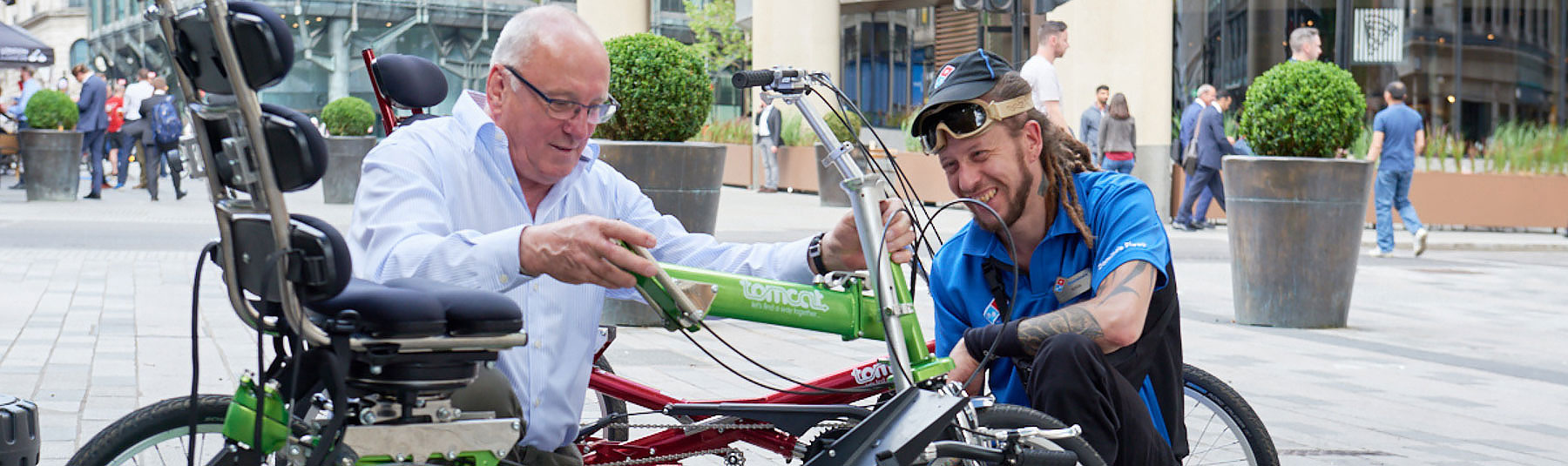
Buying a second-hand adaptive tricycle can be a good way to access specialist equipment at a lower cost. A well-built trike can provide many years of service, and it is not uncommon for a well-maintained Tomcat trike to perform almost like new even after long use.
However, there are several important things to check before purchasing a second-hand trike. The process should be approached in two stages:
-
Check the general mechanical condition of the trike
-
Check whether the trike’s specification suits the rider
Tomcat trikes are often individually designed for the rider who first used them. This means that even if a trike appears to be in good condition, it may not necessarily suit a different rider without adjustments.
This guide explains the most important things to look for when considering a second-hand tricycle.
Part 1: Check the General Condition of the Trike
Before looking at the specification or rider suitability, the first step is to make sure the trike itself is in good working condition.
A well cared for Tomcat will often look and perform as good as new after many years of service. However, a trike that has been left outside in all winds and weathers may have hidden problems such as corroded cables, seized clamp screws, locked wheels and worn transmission components. Fortunately, most of these issues are relatively easy to spot during a careful inspection.
1. Look for Signs of Rust or Neglect
Avoid trikes where the universal chrome-plated cycle components such as the bell, handlebars and stems show visible rust.
Although these standard components can usually be replaced easily and cheaply, rust often indicates that the trike has been poorly stored or neglected, and there may be additional hidden issues.
After many years of use it is perfectly normal for paintwork to show scratches, and deeper scratches may even reveal small areas of rust. This is generally not a concern. However, paint that is blistered or bubbling is often a sign of long-term exposure to the elements and should be approached with caution.
2. Check the Chain Drive
The drivetrain should operate smoothly.
Spin the right rear wheel with the left wheel on the ground and check that it rotates freely. Repeat the same process for the left wheel, allowing for slightly more resistance because of the chain drive.
Heavy resistance may indicate seized bearings or a neglected chain system.
Next, push the trike forward as fast as possible without a rider seated and listen carefully. Clicking or snatching noises can indicate a chain drive alignment problem.
3. Check the Steering and Braking Systems
If the trike has carer steering fitted, check that it turns smoothly and silently.
There should be very little slack in the steering system, even after several years of use. Excessive movement or play may indicate wear or incorrect adjustment.
If you are unfamiliar with how this system works, click here to watch a short demonstration
Check that all braking systems function correctly, including the park brake.
The brakes should engage smoothly and release fully. Reliable braking is essential for safe riding.
4. Check the Two-Piece Frame Quick Release™
Many Tomcat trikes include the Two-Piece Frame Quick Release™ system, which allows the trike to separate for transport.
Make sure the mechanism operates smoothly and that the interlock engages correctly when the frame is reconnected.
You can see how the Two-Piece Frame Quick Release™ works here.
5. Inspect the Swivel Saddle
If the trike has a Swivel Saddle, check that it turns freely and locks automatically in both directions without wobble.
This feature is designed to make mounting and dismounting easier and should operate smoothly.
6. Check Wheel Alignment and Frame Integrity
Inspect the forks and wheels carefully.
Spin each wheel to ensure it is not buckled, paying particular attention to the front wheel. Also check that the forks are straight.
Look closely at the paint around the weld area where the oval main frame tube meets the steering down tube. Cracked paint or a bent down tube in this area can indicate that the trike has suffered a heavy impact with a solid object such as a wall.
7. Confirm Accessories Are Genuine
Check that all accessories fitted to the trike are Tomcat manufactured components.
If there is a problem with a third-party addition, it may not be something that Tomcat can repair or support.
Part 2: Checking the Trike Is Suitable for the Rider
Once you are confident that the trike is mechanically sound, the next step is to ensure that the specification suits the rider.
Because Tomcat trikes are designed around the individual rider, the frame size, drive system, gearing and support accessories may have been selected for very specific needs.
A second-hand trike can be an excellent purchase, but only if it is properly matched to the rider.
1. Checking the Size of the Trike
If possible, arrange a trial ride.
If the saddle adjustment is at or near its lowest setting and the rider’s legs are almost straight when pedalling, the trike is likely to be a good match.
If you cannot try the trike in person, sizing can still be checked with a simple measurement.
Do not give the seller clues regarding the rider’s age, height, build or disability. Quoted age or height ranges are often subjective.
Instead:
-
Ask the seller to fully lower the saddle
-
Measure from the saddle crown to the pedal when the pedal is at its lowest position
Then measure the rider’s inside leg from high in the groin to the sole of their shoe when standing comfortably upright.
If the rider’s inside leg measurement is the same or up to 5 cm longer, the trike is likely to be a good match.
If it is shorter, or more than 10 cm longer, the trike is unlikely to fit properly.
2. Understanding the Transmission Ratio
The gearing of the trike determines how easy it is to pedal.
Look at the sprockets:
-
If the front sprocket is larger than the rear sprocket, the rider will need stronger legs or good walking ability.
-
If the front sprocket is smaller than the rear sprocket, the trike was likely designed for a rider with very low leg strength or stamina.
-
For many riders, similar sized sprockets front and rear provide a balanced gear ratio.
It is also important to count the number of teeth on the rear sprocket.
This will normally be 28 or 36 teeth. If it is less than 28 teeth, the trike may be a freewheeling hybrid and you are strongly advised to try before buying, as it may be too highly geared.
In many cases, riders with severe learning difficulties will struggle to pedal a trike with a free-wheel system.
3. Choosing the Right Drive System
The drive system must match the rider’s ability.
Generally speaking:
-
Riders with very mild learning difficulties or none at all may manage a multi-geared or free-wheeling drive.
-
Riders with greater than mild learning difficulties will usually require a fixed drive or a Tomcat Dual Drive™, which allows switching between fixed and free drive.
Dual drives are always provided with Trailer Trikes™.
If in doubt, check that the rider can pedal the tricycle smoothly and continuously. It is rarely effective to assume they will simply “get used to it”.
4. Checking the Footshoes
Footshoes help position and stabilise the rider’s feet on the pedals.
Measure the internal length of the footshoe.
If the rider’s shoe is 1–4 cm shorter, the size is likely to be suitable. Outside those measurements a different size footshoe may be needed.
Tomcat footshoes are adjustable front to back, sideways and with toe-in and toe-out positioning.
5. Considering Leg Supports
Leg supports (callipers) can be a complex biomechanical issue, so careful thought is required when buying second-hand.
They are often fitted to heavier special needs trikes to prevent sideways movement of the knees and pelvis caused by the greater effort required to pedal.
Because Tomcat trikes are lighter and easier to pedal, callipers are often not required.
It is also worth considering that when callipers are used, pedalling effort is transferred directly to the pedal and the ankle joint contributes very little. If cycling is intended to strengthen weak ankles, callipers may actually work against that goal.
Leg supports may be needed if:
-
The rider’s legs move excessively inward or outward when pedalling
-
The rider experiences plantarflexion or dorsiflexion of the ankles
-
The rider has diagnosed joint conditions such as hip dysplasia
In these situations it is advisable to seek guidance from a physiotherapist or healthcare professional.
6. Pelvic Support: Pommel or Lap Strap
Tomcat trikes use two types of pelvic support: a pommel or a lap strap.
While lap straps are sometimes preferred in wheelchairs to reduce pelvic tilt, the active environment of a tricycle often makes a pommel the more reliable option.
A pommel may be required when:
-
The trike is a Trailer Trike™
-
A rider has behavioural challenges
-
A rider experiences seizures
-
Additional reassurance or pelvic posture control is needed
-
Neurological movement patterns require stabilisation
If a pommel is required but not fitted, it can usually be retro-fitted, although this may increase the total cost.
7. Simple Trunk Support
Many Tomcat trikes include a Security Backrest™.
This provides containment and reassurance while also offering basic trunk support.
Measure the gap between the backrest arms to check suitability.
The arms can be widened by approximately 4 cm on each side, but if the gap is too wide or too tight you may need replacement arms.
A correct fit is important. Riders with conditions such as hemiplegia may feel vulnerable if the arm gap is too large and may lean heavily to one side.
8. More Complex Trunk Support
If the rider requires significant trunk or head support, you are entering a much more specialised clinical area.
In these cases Tomcat trikes are typically customised around the rider’s needs.
If you are considering a second-hand trike for a rider with complex support requirements, it is strongly recommended that you involve a physiotherapist or healthcare professional when assessing the trike.
Be Cautious of Online Prices and Unauthorised Sellers
When researching second-hand trikes online, it is important to be cautious about the information you find.
Tomcat has authorised assessors and distributors throughout the UK, Ireland and around the world who provide trusted guidance, correct pricing and professional support. However, there are also some web traders who copy Tomcat product photos and list the trikes on their own websites, often adding a very large margin in the hope that they can source the product later if a customer places an order.
Unfortunately, this is not how Tomcat products are supplied.
In one example, a Belgian website was found offering a Tomcat Trailer Trike at nearly four times its actual value.
If a seller of a second-hand Tomcat trike points you to an online price from a company that is not an authorised Tomcat distributor, it is wise to be cautious.
If you are unsure, you can contact Tomcat directly to confirm whether a website or dealer is authorised. This can also be a useful opportunity to learn more about the true cost of a customised Tomcat trike and explore any funding options that may be available.
In many cases, buyers are pleasantly surprised to discover what support and options are available.