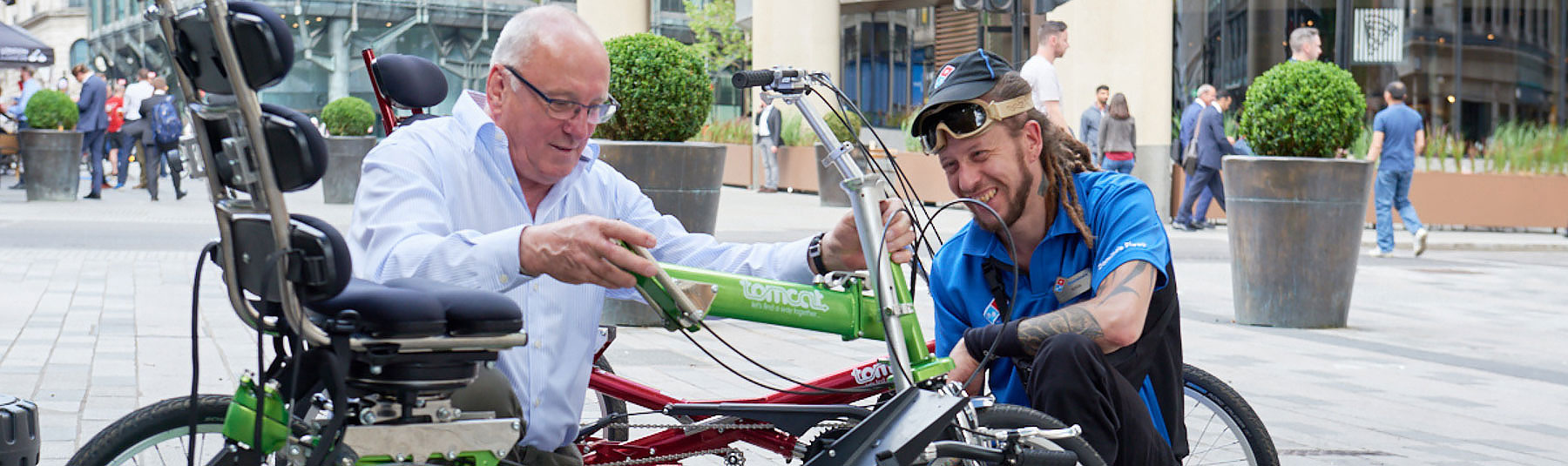
For families of children with additional needs, finding equipment that actually works is rarely straightforward. When something does, the impact goes far beyond what any price tag can capture.
Specialist trikes carry a higher cost than standard cycles, and that’s a question worth addressing honestly. So here’s where the investment actually goes, and why so many families tell us it was worth it.
Why do specialist trikes cost more?
A Tomcat trike isn’t a standard tricycle with a few extras bolted on. There are a few honest reasons why the cost is higher, and they’re all worth understanding.
The engineering is genuinely different. Some conditions, such as hypertonia, put unusual and very high stresses on equipment that would never be a factor in a standard bike. That means higher-grade materials, more rigorous design standards, and safety testing that mainstream products simply don’t require.
Volume drives cost. Every Tomcat trike is uniquely built to the individual rider, which means mass production simply isn’t possible in the way it is for other manufacturers. We build in relatively small numbers, and that means material costs are higher and certain manufacturing processes, such as die-casting or injection moulding at scale, aren’t viable for us. Every trike we make reflects that reality.
Innovation. Over more than 20 years, Tomcat has consistently invested around 25% of turnover back into innovation. That work has produced over 40 advances for the industry, including our Dual Axle and Carer Control systems, which have since become industry standards worldwide. Without that ongoing investment, the riders who benefit most from those developments simply wouldn’t have had access to them.
Service is built into what you pay. Buying off the shelf and getting it wrong is an expensive mistake with few solutions. Our approach has always been different: we assess the rider, account for conditions that may change over time, liaise with physiotherapists and other professionals, advise on funding, and make sure what arrives is exactly right. That level of care requires people, time, and expertise, and it’s reflected in the price.
What does a specialist trike actually give your child?
For many riders, a Tomcat trike is the first piece of equipment that lets them cycle independently, or close to it. That might sound like a small thing until you’ve watched your child on one for the first time.
Beyond the joy of it, there are real physical benefits. Cycling supports cardiovascular fitness, leg strength, and coordination. For riders working with a physiotherapist, it can be a meaningful part of their therapy, building muscle groups and movement patterns in a way that feels nothing like a clinical exercise.
There’s also something harder to quantify but just as real: what it does for confidence. Being able to do something that other children do, outdoors, under your own power, matters enormously to riders with additional needs.
What about funding?
Many families don’t pay the full cost themselves. There are a few routes worth exploring.
Charity grants. There are a surprising number of organisations that can help fund specialist equipment like a Tomcat trike. From national charities to condition-specific funds, grant support is more accessible than many families realise. We’ve put together a list of charities worth exploring as a starting point.
Crowdfunding. Many families have successfully used platforms like GoFundMe to raise funds for specialist equipment. It can feel daunting, but community support is often more forthcoming than you’d expect. We’ve written a guide on how to approach it.
Funding a specialist trike can feel overwhelming, but you don’t have to figure it out alone. Our team has helped many families navigate the options and we’re always happy to point you in the right direction.
How long will it last?
One of the things that makes the cost easier to justify is longevity. Tomcat trikes are built to last and, crucially, built to grow with your child. Adjustable frames and interchangeable components mean a well-maintained trike can see a rider through many years rather than being outgrown in one. That changes the maths considerably.
So, is it worth it?
We’re not a neutral party here, and we wouldn’t pretend to be. But we’ve spent more than two decades watching what happens when a rider gets the right trike. The physical gains. The shift in confidence. The moment a family realises their child is having fun, genuinely, without modification or workaround.
Our founder Bob Griffin has written about the day a young man, whose limbs are strapped to his wheelchair for his own safety, cycled for the first time on a Tomcat trike. The cost of getting there, in time, design, and persistence, was high. What it meant to him and his family was priceless.
If your child has been assessed as someone who could benefit from a specialist trike, the question of whether it’s worth the investment tends to answer itself fairly quickly.