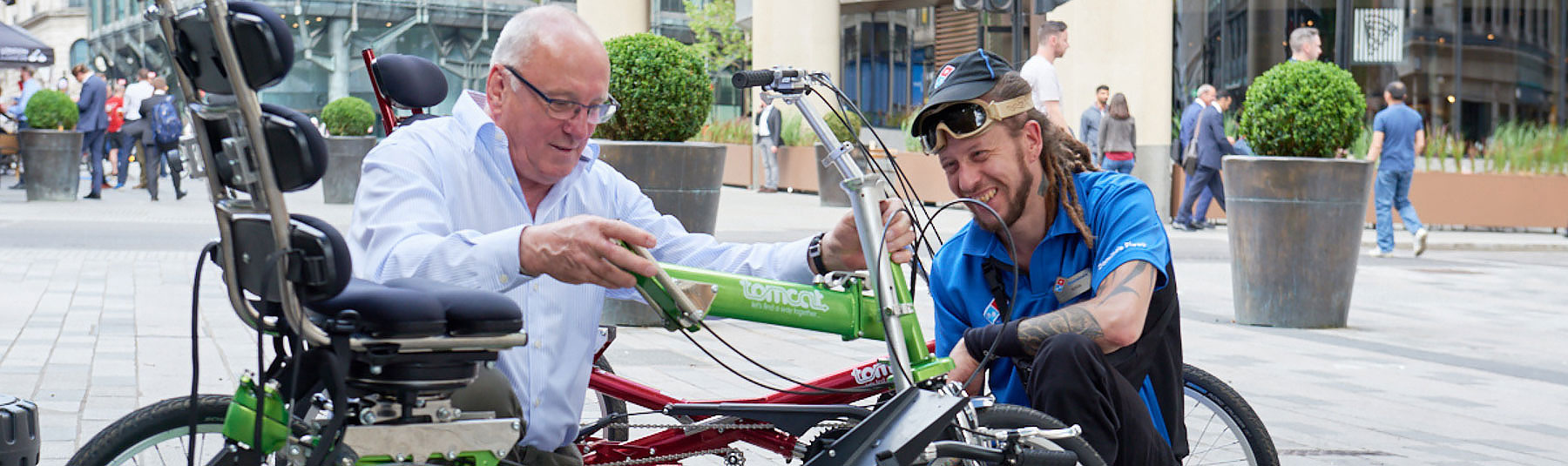
Cycling is one of the most well-researched physical activities for people with Cerebral Palsy. Cycling can improve muscle strength, balance, and gross motor function in children and adolescents with cp. But getting the right set up matters enormously. For most teenagers with CP, a standard two-wheeled bike isn’t the right starting point. Here’s what riding with Cerebral Palsy actually looks like, and what a specialist trike can offer.
Understanding how CP affects movement
Cerebral palsy is an umbrella term for a group of movement disorders caused by disturbances to the developing brain. The NHS describes three main types: spastic CP (the most common, where muscles are stiff and movements can seem jerky), dyskinetic cp (where muscles can shift between tight and floppy, causing involuntary movements), and ataxic CP (which affects balance and coordination). Many people have a mixed form.
Because CP presents so differently from person to person, there’s no universal answer to what riding will feel like, or what adaptations will be needed. What’s consistent is that the right bike, set up correctly, makes a significant difference.
Why a specialist trike makes more sense than a two-wheeler
Balance is where the standard bikes become a barrier for many CP riders. Maintaining a two wheeled bike requires continuous, automatic postural adjustments, exactly the kind of involuntary muscle control that CP can affect. A trike removes that challenge entirely.
With three points of contact on the ground, a trike is stable at rest and slow speeds. The rider doesn’t need to manage balance in the same way. That frees up cognitive and physical effort for riding, pedalling, steering, and enjoying the experience.
Tomcat features that matter for CP riders
Riders with cerebral palsy have specific needs that generic adaptations rarely meet. Every Tomcat trike is built around that reality, with features developed specifically to address the real challenges adaptive cycling presents.

Self-Centring Steering – Most low sitting trikes have a steep steering rake that causes the front wheel to drift left to right, and the heavier the rider, the worse it gets. Tomcats patented Self-Centring Steering corrects this, making the front wheel naturally return to centre. For CP riders managing spasticity or reduced fine motor control, this makes a significant difference to confidence and safety. It’s a world first, exclusive to Tomcat.

Swivel seat – Getting onto and off a trike can be one of the biggest barriers for riders with CP, particularly those with hemiplegia or reduced lower limb mobility. The Tomcat Swivel Seat allows a rider to turn the seat sideways, sit down comfortably, then swivel smoothly into the riding position. No awkward step-across required. For riders who use a hoist, this makes transfers genuinely manageable.
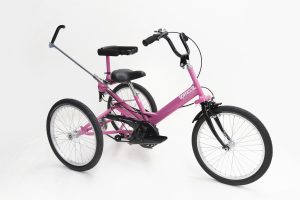
Carer Control – For riders who are building confidence or who need intermittent support, carer control allows a parent, carer, or support worker to steer and brake from behind when needed, while the rider stays in control the rest of the time.
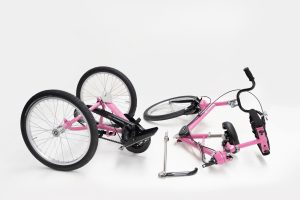
Quick release frame – The Bullets two-piece frame separates in seconds, making it easy to transport in a standard family car. For CP riders who rely on a carer for transport, this means the trike can come everywhere, days out, trips, school, without needing a specialist vehicle.

Bionic Buddy (Electric assist) – For riders whose CP affects stamina or upper motor neuron function, Tomcat’s Bionic Buddy motorises the trike at walking pace without requiring pedalling. The throttle can be controlled by either the rider or the carer, this extends the range of what’s possible on a ride and means that variation in energy or muscle tone day to day doesn’t determine how far a rider can go.
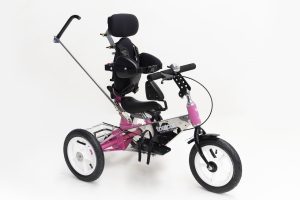
Foot, leg, trunk, and head support – All Bullet models can be fully accessorised with a range of supports to match the riders’ specific needs. For CP riders with reduced core stability or foot control, these adaptions are often what make the difference between a trike that works and one that doesn’t.
Practical tips for riding with CP
Start with shorter sessions and build gradually – The neurological benefits of cycling tend to compound with regular riding. Research suggests frequency matters: bicycle therapy is most effective when practiced at least twice a week for 20-30 minutes per session.
Work with physiotherapists on set up and goals –physiotherapist-led cycling programmes give children with CP ten-times greater odds of achieving their cycling goals compared to parent-led home programmes alone. Getting professional input and positioning in technique – particularly seat angle, foot retention, and crank length, is genuinely valuable.