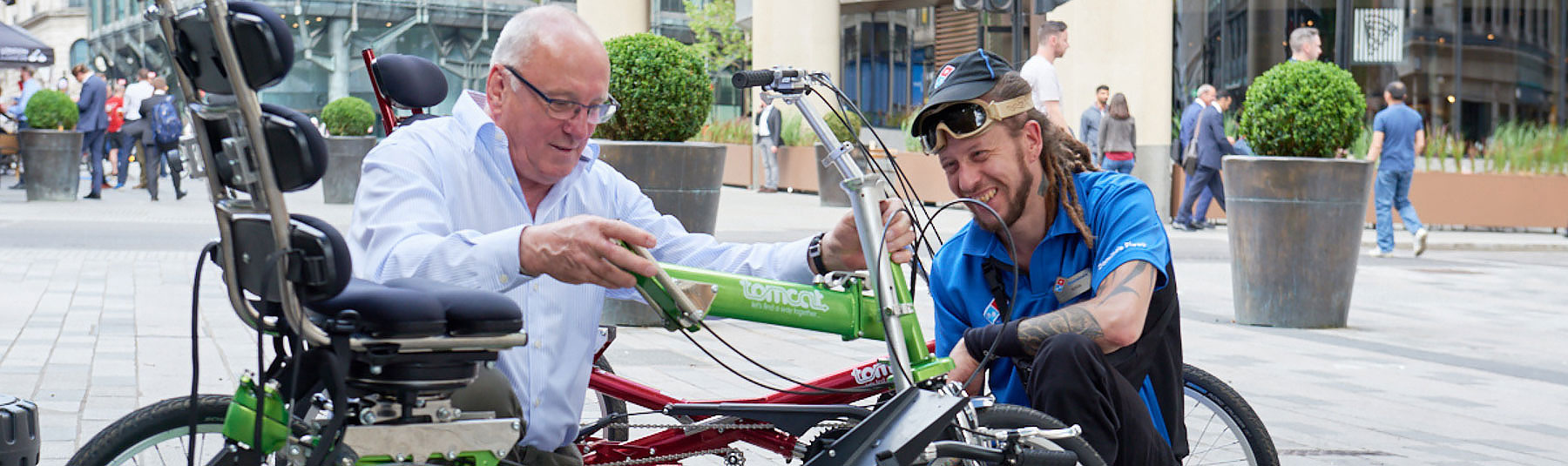
When families start looking into adaptive trikes, it’s tempting to treat them like any other piece of equipment. Find something that looks right, check the size, order it. But for children and young people with complex needs, that approach rarely works, and understanding why can save a lot of time, money, and frustration.
No two riders are the same
A child with low muscle tone has very different support needs to a child with spasticity. A rider who is still developing trunk control needs something quite different from a rider who has a fixed postural pattern. Add in factors like leg length discrepancy, hip dysplasia, visual impairment, or sensory sensitivities, and the idea of a standard solution starts to look very thin.
Off-the-shelf adaptive trikes are designed to cover as many users as possible. That’s not a criticism, it’s just what mass production requires. But when a product has to suit everyone broadly, it rarely suits anyone precisely.
Fit affects more than comfort
A poorly fitted trike isn’t just uncomfortable. It can reinforce poor posture, limit the physical benefit of riding, and put a child off cycling altogether. The positioning of foot supports, the angle of the seat, the placement of handles and trunk supports all have a direct effect on whether a rider can engage the right muscle groups and build the right movement patterns.
When a trike is built to fit a specific rider, everything works together. The rider isn’t fighting the equipment. They’re using it.
The complexity of complex needs
Families navigating additional needs are already managing a lot. Therapists, appointments, equipment assessments, funding applications. The last thing anyone needs is a trike that arrives and doesn’t quite work, or one that needs adapting after purchase in ways the manufacturer never anticipated.
This is where customisation at the point of build matters. When a trike is configured from the ground up around a rider’s specific measurements, diagnosis, and therapy goals, it’s far more likely to do what it needs to do from day one.
What customisation actually looks like in practice
Basic adaptive trikes tend to offer size variants and perhaps a handful of accessories. What they rarely offer is the ability to configure the trike around a rider’s specific physical and therapeutic needs from the start.
Tomcat trikes are different. Every build can be specified with the components that rider actually needs, not a closest match from a limited menu. Many of those components are Tomcat original innovations, developed in-house to solve problems that no off-the-shelf product could address.
For riders who need postural support, there are options for adjustable lateral supports, cushioned backrests, headrests, and lap straps, each chosen and positioned to suit that individual’s trunk control and seating needs. Seating itself can be specified across different designs, from saddle seats to fully upholstered and cushioned options, depending on what best supports the rider’s posture and comfort.
Mounting and dismounting safely is a real concern for many families, particularly in settings like schools where manual handling policies apply. Tomcat’s Swivel Saddle, combined with an access step, allows riders to transfer onto the trike independently and safely without any lifting by the carer. It was invented in 1998 specifically to solve this problem and has since enabled thousands of riders to access cycling in settings where they were previously excluded.
When a rider lacks the cognitive awareness or physical ability to safely control steering, speed, or braking, Carer Control allows a pedestrian carer to manage all of those functions from behind the trike while the rider pedals. It is Tomcat’s original signature invention, and the one most widely imitated by other manufacturers. Carer Braking extends this further, allowing the rider full steering independence while the carer retains the ability to brake when needed.
Drive and steering can also be configured to the rider. Self-Centring Steering is a patented Tomcat innovation that counterbalances the natural drift found in low-sitting trikes, keeping steering predictable and responsive throughout the ride. It is particularly valuable for riders who have a tendency toward erratic or compulsive steering movements. Different handlebar options, including loop handlebars and Tom Riley handlebars, allow the right fit for different grip abilities and arm positions. Foot shoes and leg supports are similarly chosen to suit the individual.
The Dual Axle is another Tomcat original, developed initially for riders with epilepsy who need the trike’s fixed drive to disengage quickly after a seizure so the trike can be pushed to safety without the pedals rotating. It has since proven useful across a wide range of conditions and is also what makes Tomcat’s Trailer Trike possible, allowing the trike to convert and be towed behind a carer’s bicycle so the whole family can ride together.
For riders or families who want to extend their range or tackle more challenging terrain, the Bionic Buddy is a throttle-controlled e-drive accessory that propels the trike at up to 3mph without the rider needing to pedal. It is particularly suited to riders with limited strength or stamina, and because its maximum speed is regulated to a brisk walking pace, it is fully compliant with UK law for use on public pathways.
Built for now, designed to grow
One concern family often raise is whether a trike built so specifically to one rider’s needs will quickly become redundant. It’s a fair question. But components like leg length adjustment and the adjustable sliding seat are designed with exactly this in mind. The fit is precise from day one, and it moves with the rider as they develop. That means the trike doesn’t need replacing every time a rider grows or their needs shift. The investment stretches further than it might first appear.
Why this matters when weighing up options
Families comparing adaptive trikes are often comparing prices as much as products. An off-the-shelf option will almost always look cheaper upfront. But if it doesn’t fit well, doesn’t support the rider properly, and doesn’t deliver the developmental or therapeutic benefit it should, it hasn’t saved anything. It’s created a new problem.
Customisation isn’t a premium feature. For riders with complex needs, it’s the baseline requirement.