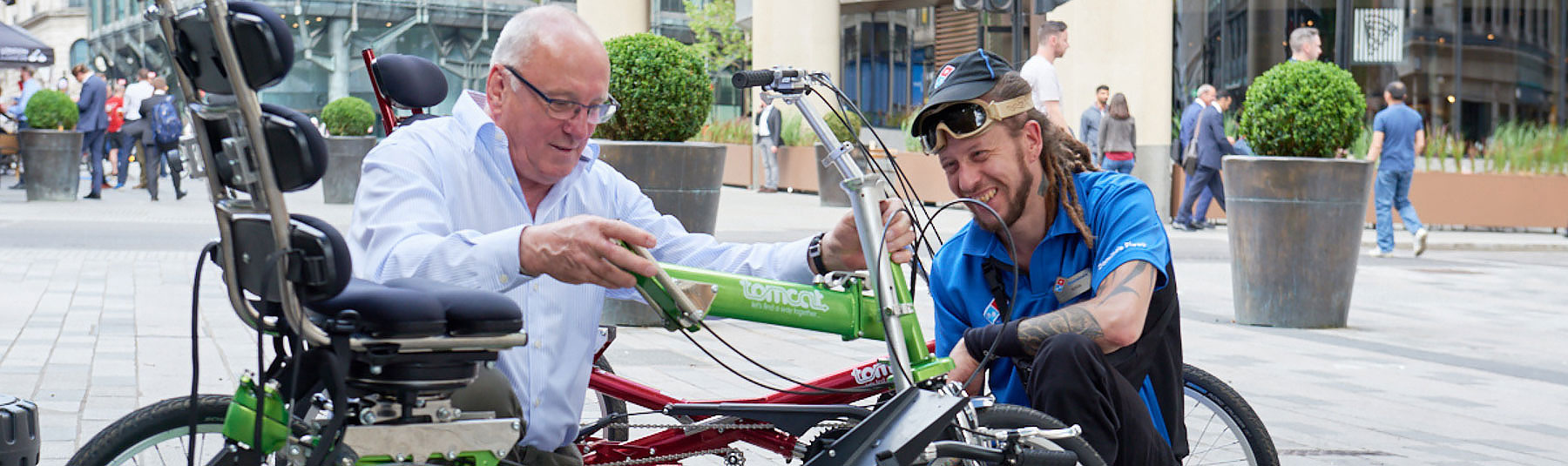
A trailer trike is not a single piece of equipment. It is two things working together: your own personalised Tomcat trike, and a trailer bar that connects it to a two-wheeled bike ridden by a parent, carer, or friend. Together, they create a riding experience that feels worlds apart from other assisted cycling options.
Your personalised trike and the trailer bar
Every trailer setup starts with a fully customised Tomcat trike, whether that is a Fizz, Rotor, Silver, or Apprentice. It is built and fitted to the rider’s individual needs, from the frame size to the seating and support. This is not a generic piece of kit. It is a trike that belongs to the rider, designed around them, and set up exactly the way they need it.
And importantly, it is a trike that can be ridden completely independently. The trailer bar is an addition to the trike, not a replacement for it.
The trailer bar
The trailer bar is what makes the connection possible. Using Tomcat’s quick-release frame mechanism, the trike splits into two parts. One end of the trailer bar attaches to the back end of the trike, and the other connects to a two-wheeled bike ridden by a parent, carer, or friend. The seat and handlebars come as part of the bar, so everything the rider needs is still right there in front of them.
How it all connects
The result is something that feels surprisingly familiar. Even though the trike has been split and connected to another bike, the rider’s experience feels much the same as if they were on their own trike. The seat is there. The handlebars are there. The pedals are there. It looks and feels like riding, because in many ways, it is.
On a side-by-side bike, or a bike with a seat attached to the back, the rider is a passenger. They may be physically present in the ride, but they are not part of it. Someone else is steering, someone else is pedalling, and the rider is simply along for the journey. For many riders, that distinction matters more than people realise.
With a trailer trike, that changes completely. During trailer conversion, freewheel drive is enabled. This means the rider can turn the pedals as much or as little as they like, without it having any effect on the movement of the trike. They are not controlling the speed, but they are moving their legs, feeling the rhythm of the ride, and experiencing what it feels like to pedal.
The same goes for the handlebars. The rider can hold them, lean into bends, and feel like they are guiding the trike, even though the steering is being managed by the person on the two-wheeled bike. It is not about pretending. It is about giving the rider a genuine sense of participation in something they might otherwise only ever watch from the sidelines.
Building confidence for independent riding
The trailer is not just about enjoying a ride together. It is also a stepping stone. Because the rider is actively pedalling during trailer use, they are building the leg rotation and muscle memory that independent riding requires. Over time, that movement becomes more natural, more automatic, and more confident.
For riders who are working towards riding independently, the trailer trike gives them a way to practise without the pressure. They are not sitting still. They are not being pushed along. They are developing real skills in a supported environment, at their own pace.
And when that moment comes, when the rider is ready to take on the trike by themselves, they do not have to wait. Because the trike is already there. Already built, already fitted, already theirs. The trailer bar comes off, the trike goes back together, and they are ready to ride.
That continuity matters. There is no transition to a completely new piece of equipment, no period of adjustment, no starting from scratch. The trike they have been riding in trailer mode is the same trike they will ride independently. They already know it, and it already knows them.